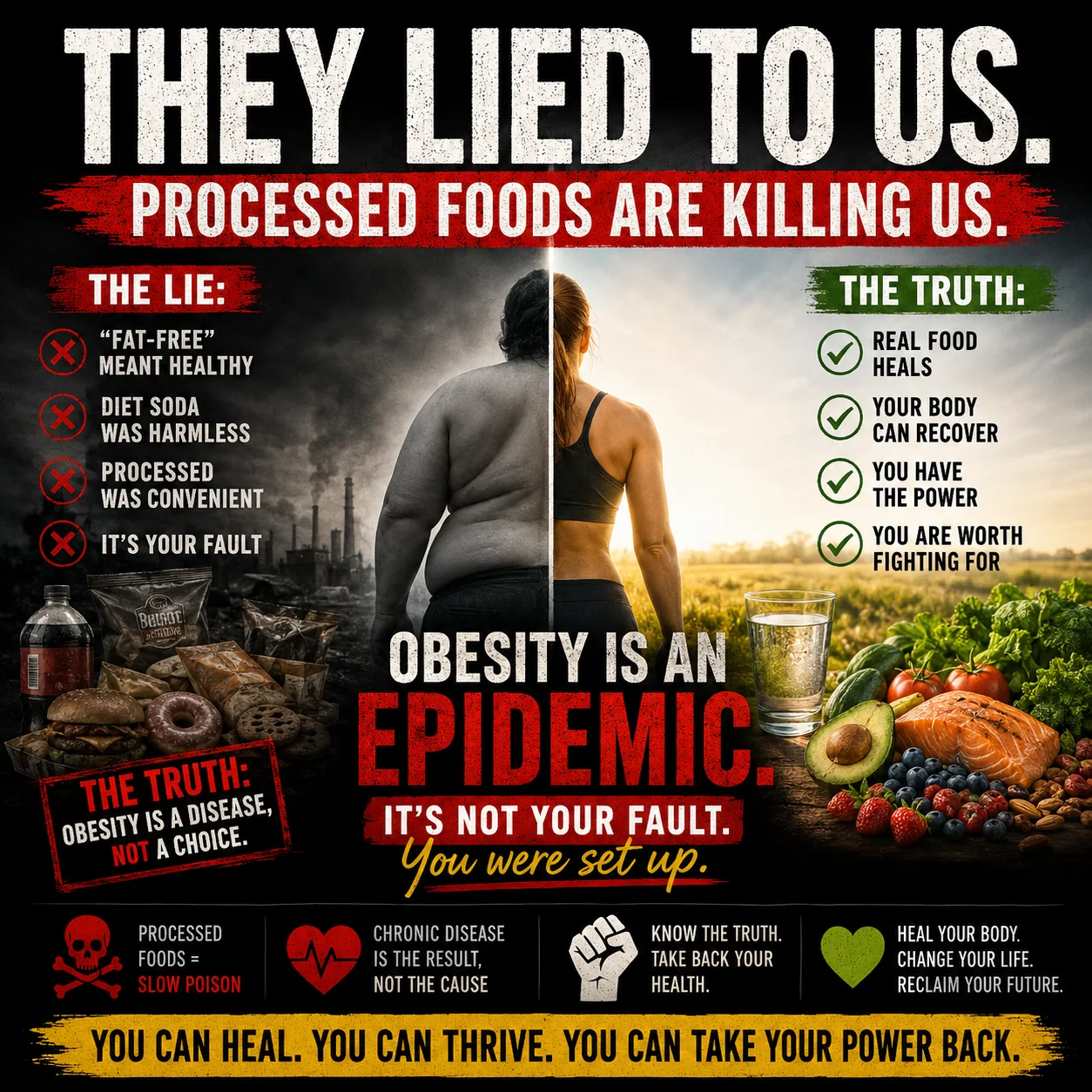
The American grocery store changed radically between the 1970s and today. What changed — and why — is a story most people have never fully heard.
60-Second Summary — What You Need to Know
- U.S. adult obesity rose from~15% in the late 1970s to 42.4% today— a near-tripling in two generations. (CDC, NHANES)
- Oklahoma currently has one of the highest obesity rates in the nation —38.7% of Oklahoma adults live with obesity, ranking #3 nationally. (CDC BRFSS, 2023)
- In the 1980s, tobacco giantsPhilip Morris and R.J. Reynolds purchased Kraft, General Foods, and Nabisco— bringing cigarette-industry behavioral science into the food supply.
- The sugar industrysecretly paid Harvard scientiststo shift the blame for heart disease from sugar to fat, shaping dietary policy for 50 years. (JAMA Internal Medicine, 2016)
- A landmark2019 NIH randomized controlled trialshowed ultra-processed food caused people to eat 500 more calories per day and gain weight — even when nutrients looked matched on paper.
- 3 in 4 American adultsnow have at least one chronic condition. $4.5 trillion per year is spent on healthcare — mostly treating diet-related diseases. (CDC, CMS 2022)
- The science is clear:you didn't suddenly become weak.The food environment was engineered around you.
- And for the first time,modern medicine has tools— GLP-1 therapies, whole-food eating patterns, metabolic monitoring, strength training — that address the biology directly.
The Numbers That Changed Everything
Before we get into what happened, look at what happenedto us. These statistics come from the CDC, NIH, American Heart Association, and Centers for Medicare & Medicaid Services — not from any advocacy group.
42.4%
of U.S. adults have obesity today — up from 15% in the late 1970s
CDC NHANES, 2020
38.7%
of Oklahoma adults live with obesity — #3 highest rate in the nation
CDC BRFSS, 2023
$4.5T
annual U.S. healthcare spending — 90 cents of every dollar on chronic disease
CMS, 2022
500
extra calories/day consumed on an ultra-processed diet vs. whole food — in a controlled NIH trial
Hall et al., Cell Metabolism, 2019
57%
of daily calories for the average American now come from ultra-processed foods
Monteiro et al., BMJ Open, 2019
3 in 4
American adults have at least one chronic health condition tied to diet and metabolic health
CDC, 2023
19.7%
of U.S. children aged 2–19 now have obesity — compared to under 5% in the 1970s
CDC NHANES, 2020
The Obesity Timeline — What the Data Shows
The rise in obesity wasn't gradual across all decades equally. It accelerated sharply starting in the 1980s — exactly when the American food supply was being most radically restructured. This is not a coincidence researchers ignore.
U.S. Adult Obesity Rate by Decade — CDC NHANES Data
Source: CDC National Health and Nutrition Examination Survey (NHANES), published data series 1960–2020. Bar widths are proportional to percentage.
Part 1: How Big Tobacco Bought America's Food Supply
This is not a conspiracy theory. It is documented corporate history.
By the late 1970s and early 1980s, the tobacco industry faced its most dangerous era yet — lawsuits, mounting public health evidence, and declining smoking rates. Tobacco companies responded by aggressively diversifying into other consumer industries. Their primary target: food.
DOCUMENTED CORPORATE ACQUISITIONS — PUBLIC RECORD
Philip Morris acquires General Foods — $5.75 billion
Brands included: Maxwell House coffee, Jell-O, Kool-Aid, Post cereals, Birds Eye frozen foods.Source: General Foods acquisition records, Federal Trade Commission filings, Encyclopedia Britannica.
R.J. Reynolds acquires Nabisco Brands — $4.9 billion
Brands included: Oreo, Ritz crackers, Chips Ahoy!, Fig Newtons, Nutter Butter, Planters nuts.Source: R.J. Reynolds Industries annual reports, SEC filings, University of Michigan LSA research brief.
Philip Morris acquires Kraft — $12.9 billion
Brands included: Kraft Mac & Cheese, Velveeta, Philadelphia cream cheese, Lunchables, Oscar Mayer. At the time, the largest non-oil corporate acquisition in U.S. history.Source: Kraft Foods history, Encyclopedia Britannica, Federal Reserve historical records.
Note: These acquisitions are verified public corporate history. Philip Morris later renamed itself Altria Group (2003). Kraft was eventually spun off and merged with Heinz in 2015 to form Kraft Heinz.
Why does this matter?
Researchers at the University of Michigan and public health institutions argue that tobacco companies entered the food industry with a critical competitive advantage:they understood addiction. They had spent decades studying dopamine response, craving cycles, sensory stimulation, flavor engineering, repeat-consumption psychology, and impulse marketing — all tools originally developed to keep people smoking.
Multiple food scientists and historians, including those cited byThe New York Times,The Guardian, and in peer-reviewed public health journals, have argued that this institutional knowledge was applied to food engineering — resulting in products specifically designed to maximize repeat purchases and override natural fullness signals.
What researchers call "hyper-palatability"
Food scientist Howard Moskowitz — whose work was profiled in Michael Moss's Pulitzer Prize-winning reporting and bookSalt Sugar Fat(Random House, 2013) — described how food companies used sensory testing to find "the bliss point": the precise combination of sugar, salt, fat, and texture that maximizes craving and minimizes satisfaction. The engineering goal was not fullness. It was repeat consumption.
Part 2: The Harvard Scientists Who Were Paid to Blame Fat
In 2016, investigative journalists and researchers at the University of California, San Francisco published a landmark study inJAMA Internal Medicinethat shook the nutrition science world.
After reviewing 50-year-old sugar industry documents obtained from archives, researchers Cristin Kearns, Laura Schmidt, and Stanton Glantz documented that the Sugar Research Foundation (now the Sugar Association) had paid the equivalent of approximately $50,000 in today's dollars to three Harvard scientists in the 1960s. The scientists were paid to review studies and publish research that minimized the link between sugar and heart disease — and redirected scientific attention toward dietary fat instead.
The Study — Published Source
Kearns CE, Schmidt LA, Glantz SA."Sugar Industry and Coronary Heart Disease Research: A Historical Analysis of Internal Industry Documents."JAMA Internal Medicine.2016;176(11):1680–1685.
The study was covered by NPR, The New York Times, The Guardian, Vox, and major medical journals. Lead author Cristin Kearns was a dentist and researcher at UCSF. The findings were not contested by the Sugar Association on factual grounds — they argued the payments were standard academic practice at the time.
The downstream effect was profound. From the late 1970s through the 1990s, official U.S. dietary guidelines and the food industry promoted a low-fat narrative. Grocery stores filled with fat-free cookies, low-fat yogurts, reduced-fat processed snacks, and diet desserts. When manufacturers removed fat, they typically replaced it with sugar, refined starches, and chemical flavor additives to maintain taste.
The result: Americans ate more sugar while believing they were eating healthy. Insulin resistance climbed. Metabolic syndrome rates soared. And a generation of people blamed themselves for lacking willpower — not realizing the game board had been tilted before they sat down.
Part 3: The NIH Study That Proved It — With Science, Not Opinion
In 2019, Kevin D. Hall, Ph.D. at the National Institute of Diabetes and Digestive and Kidney Diseases (NIDDK), part of NIH, published the first everrandomized controlled trialdirectly comparing ultra-processed to minimally processed diets — in a fully controlled inpatient setting.
The Kevin Hall / NIH Ultra-Processed Food Trial — Key Results
+500
extra calories per day consumed by participants on the ultra-processed diet — spontaneously, without being asked to overeat
+2 lbs
of body weight gained in just 2 weeks on the ultra-processed diet — while the whole-food group lost ~2 lbs
Matched
calorie, sugar, fat, fiber, and macronutrient content between the two diets — the difference was the degree of processing, not the numbers on paper
Source: Hall KD, et al. "Ultra-Processed Diets Cause Excess Calorie Intake and Weight Gain." Cell Metabolism. 2019;30(1):67-77.e3. DOI: 10.1016/j.cmet.2019.05.008. Published by NIH/NIDDK.
This was not a survey or a food-recall study. This was a controlled inpatient experiment where every meal was provided. The conclusion was clear: ultra-processed food causes people to eat more and gain weight — regardless of what the nutrition label appears to say.
Part 4: What This Did to the American Body
The chronic disease crisis in the United States did not emerge from nothing. A large and growing body of peer-reviewed research links ultra-processed food consumption to a cascade of health consequences.
🔥 Type 2 Diabetes
37.3 million Americans — 11.3% of the population. Pre-diabetes affects another 96 million. Strongly associated with ultra-processed food intake and insulin resistance.(CDC Diabetes Statistics Report, 2022)
🫀 Heart Disease
Still the #1 cause of death in the U.S. The American Heart Association links ultra-processed food to significantly elevated cardiovascular risk.(AHA Circulation, 2024)
🧠 Depression & Anxiety
Multiple large cohort studies link ultra-processed food intake with significantly higher rates of depression and anxiety — including a 2023 BMJ study of 266,000 people across 41 countries.(Lane et al., BMJ, 2023)
🫁 Fatty Liver Disease
Nonalcoholic fatty liver disease (NAFLD) now affects an estimated 100 million Americans — a condition virtually unknown before the 1980s. Strongly associated with fructose and ultra-processed food intake.(NIH NIDDK, 2021)
Part 5: Oklahoma Is Fighting Back — And Winning
Oklahoma has one of the highest obesity rates in the country. But that statistic does not define our future — it defines the size of the problem we are solving together. Oklahoma families deserve access to physician-supervised medical care that actually works.
The 10 Evidence-Based Steps to Start Reversing the Damage
- Crowding out, not cold turkey.Replace ultra-processed items one at a time rather than overhauling overnight. Sustainable change beats dramatic resets that last 4 days.
- Prioritize protein at every meal.Protein is the most satiating macronutrient. 25–35g per meal reduces hunger signals significantly (research from Purdue, University of Missouri).
- Read ingredient lists — not just nutrition labels.If you cannot pronounce more than 3 ingredients or the list exceeds 10 items, put it back.
- Eliminate liquid sugar first.Sodas, sweetened coffees, juices, and energy drinks are the single most concentrated source of metabolic disruption. Water, sparkling water, or unsweetened drinks only.
- Eat mostly foods without a label.Eggs, meat, fish, vegetables, fruit, legumes, nuts — these don't need packaging that makes claims.
- Sleep 7–9 hours.Sleep deprivation raises ghrelin (hunger hormone) and lowers leptin (satiety hormone) within 48 hours. Poor sleep is a metabolic event, not just tiredness.
- Resistance training 2–3x per week.Muscle tissue improves insulin sensitivity even at rest. This is the most metabolically efficient exercise investment you can make.
- Manage chronic stress actively.Cortisol promotes abdominal fat storage. Even 10 minutes of daily stress reduction (walking, breathing, prayer, journaling) matters.
- Track what you eat for 2 weeks.Not to obsess — to see patterns. Most people are shocked by how much ultra-processed food appears without them noticing.
- Talk to a physician about GLP-1 therapy.If you have been doing all of the above and the biology still resists — that is not a personal failure. That is a medical situation that now has a medical answer.
Where GLP-1 Therapy Fits In
GLP-1 receptor agonists — including semaglutide (Wegovy, Ozempic) and tirzepatide (Zepbound, Mounjaro) — work at the root of why ultra-processed food causes weight gain: the neurobiological signals that override willpower. They quiet food noise. They reset hunger. They improve insulin response.
They do not replace good nutrition. They make good nutrition possible for people whose biology has been working against them for years — or decades.
Oklahoma Trim Clinic — Built for Oklahoma
We are physician-supervised, telehealth-accessible, and here for Oklahomans who are ready to stop blaming themselves and start getting real help. Semaglutide is one medication option. Semaglutide from $149/month. Tirzepatide from $169/month.
No membership fee · No contract · No annual commitment · No required prepayment · Free shipping · Free consultation
Your exact price depends on your prescribed dose. Your provider confirms it before you pay.
References
- Flegal KM, et al. Prevalence of Obesity and Trends in the Distribution of Body Mass Index Among US Adults.JAMA, 2012;307(5):491–497.
- CDC NHANES. Adult Obesity Prevalence Maps. Centers for Disease Control and Prevention, 2020.cdc.gov
- Kearns CE, Schmidt LA, Glantz SA. Sugar Industry and Coronary Heart Disease Research.JAMA Internal Medicine, 2016;176(11):1680–1685.
- Hall KD, et al. Ultra-Processed Diets Cause Excess Calorie Intake and Weight Gain.Cell Metabolism, 2019;30(1):67–77.
- Monteiro CA, et al. Ultra-processed foods: what they are and how to identify them.Public Health Nutrition, 2019;22(5):936–941.
- CDC. Behavioral Risk Factor Surveillance System 2023. State Obesity Prevalence Data.cdc.gov
- Moss M.Salt Sugar Fat: How the Food Giants Hooked Us.Random House, 2013.
- Wilding JPH, et al. (STEP 1). Once-Weekly Semaglutide in Adults with Overweight or Obesity.NEJM, 2021;384:989–1002.
- Jastreboff AM, et al. (SURMOUNT-1). Tirzepatide Once Weekly for the Treatment of Obesity.NEJM, 2022;387:205–216.
Ready to Get Started?
Book a free consultation to see if GLP-1 therapy is right for you.
Related Articles
Disclaimer: This article is for informational purposes only and does not constitute medical advice. Individual results vary. Consult a licensed physician before starting any weight loss program.